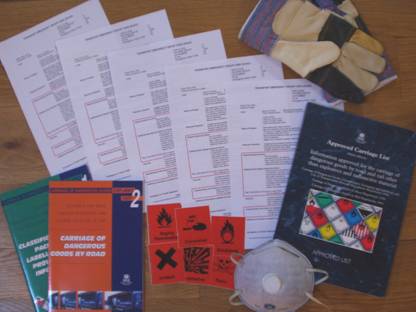
Have you ever wondered what those orange plates are on the side of tankers, why are they there and who puts them there?
Well the answer to who puts them there is simple: that’s the Dangerous Goods Safety Advisor, but the answers to the other questions are not so simple and it doesn’t just apply to tankers! Do you supply, deliver or return small packages of chemicals? Then you may fall into the Dangerous Goods Regulations
If you load/unload or transport Dangerous Goods the new E.C. Directive 96/35 requires you to appoint a fully qualified Dangerous Goods Safety Advisor (DGSA) by 1st January 2000
The general duty of the DGSA is to advise the head of the undertaking on how to achieve the safe transport and handling of these goods, in compliance with national and international Regulations. The DGSA has to be qualified by passing an examination conducted by the Scottish Regulations Authority, as agents for the Department of Transport, Environment, and the Regions (DETR).
It’s now probable that a large number of companies impacted by the new UK DGSA legislation will not be in compliance by simply ignoring it. As such they will be liable to fines of up to £5000 for each offence, following an inspection by the HSE. In addition, if an accident occurred whereby a company should have appointed a DGSA but did not, then a private prosecution for negligence, could involve massive damages. Current estimates indicate around 3000 people have qualified as DGSA's, this contrasts dramatically with the 10,000 - 15000 the UK government has estimated will be required by firms impacted by the new regulations.
Many companies are unsure whether they come under the scope of the new law, unfortunately you require a DGSA or somebody familiar with the legislation to answer this question!
Also, what if the company carries out an operation (e.g. return of product, transfer of paint to another site etc) which falls into the legislation at a later date, they again, need somebody familiar with the legislation to determine the legalities. Any company with a potential to be covered by these regulations requires access to either a DGSA or a similarly experienced person.
The fine of £5000 itself may be considered relatively minor, but the PR implications and private prosecution potential may overshadow this considerably.